Personalized Recommendations: Boost AOV 10% by 2025

Implementing advanced personalized recommendations is crucial for e-commerce businesses aiming to achieve a 10% uplift in Average Order Value by 2025, leveraging data to enhance customer engagement and drive significant financial impact.
In the rapidly evolving landscape of online retail, understanding and anticipating customer needs is no longer a luxury but a necessity. The strategic application of personalized recommendations e-commerce is emerging as a cornerstone for businesses aiming to significantly enhance their Average Order Value (AOV) by 2025.
The imperative of personalization in modern e-commerce
The digital marketplace is saturated, and consumers are increasingly discerning. Generic shopping experiences no longer cut it. Modern shoppers expect a tailored journey, one that understands their preferences, anticipates their desires, and presents them with products that genuinely resonate. This shift in consumer expectation elevates personalization from a mere feature to a fundamental business strategy.
Personalization, at its core, is about creating a one-to-one connection with each customer. It leverages data to deliver relevant content, offers, and product suggestions, making the shopping experience feel unique and curated. For e-commerce businesses, this translates directly into higher engagement, increased conversion rates, and, most importantly, a substantial boost in Average Order Value.
Understanding customer data for effective recommendations
The foundation of any successful personalized recommendation engine lies in robust data collection and analysis. Without a deep understanding of customer behavior, preferences, and demographics, recommendations remain superficial. It’s about moving beyond simple purchase history to encompass a holistic view of the customer.
- Browse History: Analyzing pages visited, products viewed, and time spent on specific items.
- Purchase History: Understanding past purchases, frequency, and value.
- Demographic Data: Age, location, gender, and other relevant attributes.
- Real-time Behavior: Capturing current session activity, such as items added to cart or search queries.
By effectively consolidating and interpreting these diverse data points, e-commerce platforms can construct a comprehensive customer profile. This profile then serves as the blueprint for delivering highly relevant and impactful product suggestions, ultimately guiding customers towards larger and more satisfying purchases within the online store.
Leveraging AI and machine learning for superior recommendations
The sheer volume and complexity of customer data necessitate advanced technological solutions. Artificial Intelligence (AI) and Machine Learning (ML) are the driving forces behind truly intelligent and dynamic personalized recommendation systems. These technologies allow businesses to move beyond rule-based recommendations to predictive and adaptive models.
Traditional recommendation engines often rely on simple algorithms, such as ‘customers who bought this also bought that.’ While effective to a degree, these methods lack the nuance and predictive power of AI/ML. Modern systems can identify subtle patterns, predict future behavior, and adapt recommendations in real-time based on evolving customer interactions.
Types of AI-powered recommendation algorithms
Different algorithms serve distinct purposes, and a combination often yields the best results. Understanding these types helps in strategically deploying them:
- Collaborative Filtering: Recommends items based on the preferences of similar users.
- Content-Based Filtering: Suggests items similar to those a user has liked in the past, based on item attributes.
- Hybrid Recommendation Systems: Combines collaborative and content-based approaches for more accurate and diverse recommendations.
- Deep Learning Models: Utilizes neural networks to uncover complex patterns in user behavior and item characteristics, leading to highly sophisticated suggestions.
The continuous learning capability of AI/ML models means that recommendations become progressively smarter and more effective over time. As more data is gathered and customer interactions are observed, the system refines its understanding, leading to an iterative improvement in recommendation quality and, consequently, a positive impact on AOV.
Practical strategies for implementing personalized recommendations
Implementing personalized recommendations isn’t just about choosing the right software; it involves a holistic strategy that integrates these systems into various touchpoints of the customer journey. From initial browsing to post-purchase engagement, every interaction is an opportunity to personalize.
A well-executed personalization strategy considers the entire customer lifecycle. It’s not enough to simply display recommended products on a product page; these suggestions should be woven into the fabric of the shopping experience, appearing naturally and helpfully where they can make the most impact.
Key placement and timing of recommendations
The effectiveness of recommendations is heavily dependent on where and when they are presented to the customer. Strategic placement ensures maximum visibility and relevance.
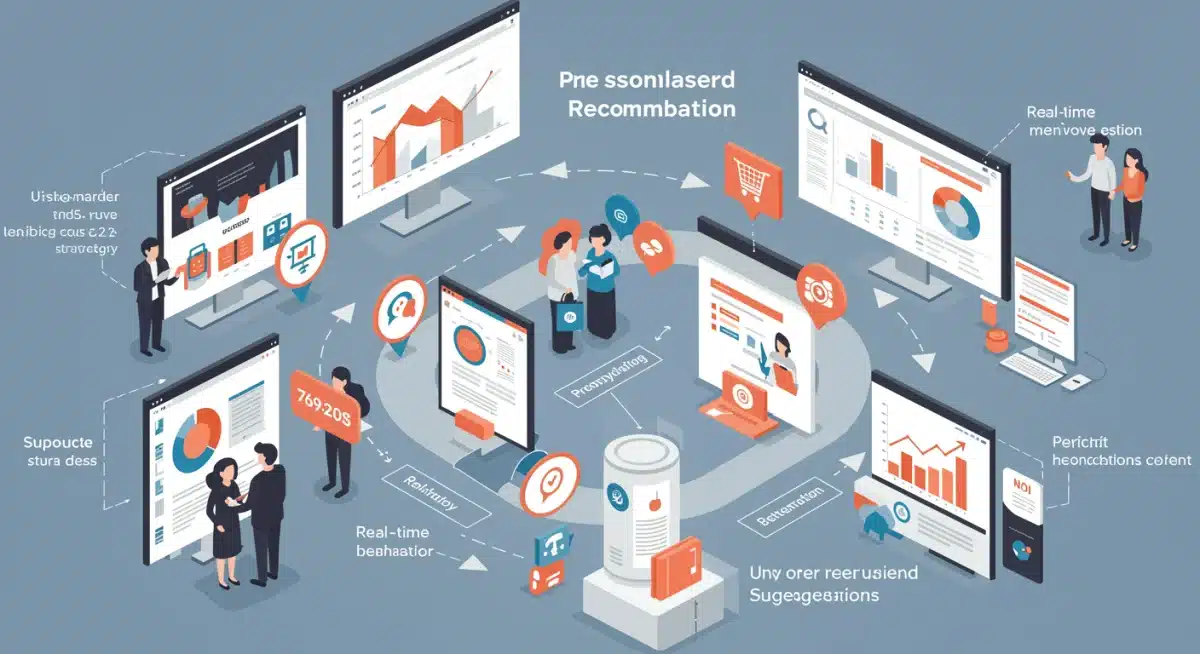
Consider these critical touchpoints:
- Homepage: ‘Recommended for you’ sections based on past activity.
- Product Pages: ‘Customers also viewed,’ ‘Frequently bought together,’ and ‘Similar items.’
- Shopping Cart: ‘Don’t forget these’ or ‘Add-on items’ to increase basket size.
- Email Marketing: Personalized product newsletters and abandoned cart reminders with relevant suggestions.
- Post-Purchase: Recommendations for complementary products or re-orders.
By strategically integrating personalized recommendations across these various touchpoints, businesses can consistently engage customers with relevant offerings, subtly encouraging them to explore more products and ultimately increasing their spending per transaction. This continuous engagement fosters a sense of being understood, leading to greater customer loyalty.
Measuring the financial impact: achieving a 10% AOV uplift
The ultimate goal of implementing personalized recommendations is to drive tangible business results, primarily through an uplift in Average Order Value. Quantifying this impact requires careful measurement and analysis of key performance indicators (KPIs).
Achieving a 10% AOV uplift by 2025 is an ambitious yet attainable target for businesses that strategically invest in and optimize their personalization efforts. This uplift doesn’t happen overnight; it’s a cumulative effect of improved customer experience, increased conversion rates, and higher basket sizes, all driven by effective recommendations.
Key metrics for tracking AOV and personalization ROI
To accurately assess the financial benefits, businesses must track specific metrics that directly correlate with personalized recommendation performance. This data-driven approach ensures that investments are yielding the desired returns.
- Average Order Value (AOV): The primary metric to track, comparing AOV for customers exposed to recommendations versus those who aren’t.
- Conversion Rate: The percentage of visitors who make a purchase, often boosted by relevant suggestions.
- Items per Order: An increase indicates successful cross-selling and up-selling via recommendations.
- Revenue per Session: Measures the total revenue generated from a single user session, reflecting overall engagement.
- Return on Investment (ROI): Comparing the cost of the recommendation system against the additional revenue generated.
Regularly monitoring these metrics allows businesses to fine-tune their recommendation strategies, identify what’s working well, and pivot from approaches that are not delivering the expected results. This iterative optimization is key to not only achieving but also sustaining a significant AOV uplift.
Overcoming challenges and future trends in personalization
While the benefits of personalized recommendations are clear, their implementation is not without challenges. Data privacy concerns, technological complexities, and the need for continuous optimization are hurdles that businesses must navigate effectively. The landscape of e-commerce is constantly evolving, and personalization strategies must adapt accordingly.
Looking ahead, the future of personalization will be shaped by advancements in AI, the increasing importance of ethical data practices, and the integration of new technologies like augmented reality. Businesses that stay ahead of these trends will be best positioned to capitalize on the full potential of personalized recommendations.
Navigating data privacy and ethical considerations
As personalization becomes more sophisticated, so does the scrutiny around data usage. Building and maintaining customer trust is paramount.
- Transparency: Clearly communicate how customer data is collected and used.
- Consent: Obtain explicit consent for data collection, especially for sensitive information.
- Security: Implement robust security measures to protect customer data from breaches.
- Control: Provide customers with options to manage their data and personalization preferences.
Adhering to strict data privacy regulations like GDPR and CCPA is not just a legal requirement but a fundamental aspect of building a trustworthy brand. Ethical data practices foster customer loyalty and ensure that personalization efforts are sustainable in the long run. Consumers are increasingly aware of their data rights, and businesses that respect these rights will gain a competitive advantage.
The evolving role of customer experience in personalization
Beyond driving sales, personalized recommendations play a critical role in enhancing the overall customer experience. A positive, seamless, and intuitive shopping journey is a powerful differentiator in today’s competitive e-commerce environment. When customers feel understood and valued, they are more likely to return, recommend, and spend more.
The goal is to move beyond mere transactions to building lasting relationships. Personalized recommendations contribute significantly to this by making every interaction feel less transactional and more like a helpful, guided exploration. This shift from transaction to relationship cultivates brand loyalty and advocacy.
Personalization as a loyalty driver
A superior customer experience, fueled by effective personalization, is a key driver of loyalty. When customers consistently find relevant products and feel their preferences are acknowledged, their connection to the brand deepens.
- Increased Engagement: Customers spend more time on sites that offer relevant content.
- Higher Satisfaction: Finding desired products easily leads to a more satisfying shopping experience.
- Reduced Churn: Personalized experiences reduce the likelihood of customers seeking alternatives.
- Brand Advocacy: Satisfied customers are more likely to share their positive experiences.
Ultimately, personalized recommendations are not just about boosting AOV in the short term; they are about cultivating a loyal customer base that will continue to drive revenue and growth in the long term. By focusing on the customer experience, businesses can unlock sustained financial success and build a resilient e-commerce presence for years to come.
| Key Aspect | Brief Description |
|---|---|
| Data-Driven Insights | Utilizing comprehensive customer data for precise and relevant product suggestions. |
| AI/ML Integration | Employing advanced algorithms for predictive, real-time, and adaptive recommendations. |
| Strategic Placement | Optimizing where and when recommendations appear across the customer journey. |
| AOV Uplift Measurement | Tracking key KPIs to quantify the financial return on personalization investments. |
Frequently asked questions about personalized recommendations
Personalized recommendations are product or content suggestions tailored to individual customer preferences, behaviors, and past interactions. They leverage data analytics and AI to create a unique shopping experience for each user, aiming to increase relevance and engagement.
By suggesting complementary or higher-value products based on a customer’s specific interests, personalized recommendations encourage cross-selling and up-selling. This strategic guidance leads customers to add more items to their cart or choose more expensive options, directly increasing the Average Order Value.
Key data includes browse history, purchase history, real-time session behavior, demographic information, and interactions with marketing campaigns. A comprehensive understanding of these data points allows for the creation of accurate and highly relevant recommendation algorithms.
AI and Machine Learning enable sophisticated analysis of vast datasets, identifying complex patterns and predicting customer preferences. They power dynamic recommendation engines that adapt in real-time, offering more accurate, diverse, and effective suggestions than traditional rule-based systems.
Future trends include hyper-personalization using deep learning, integration with voice commerce and augmented reality, increased focus on ethical AI and data privacy, and real-time personalization across all customer touchpoints for a seamless, individualized shopping journey.
Conclusion
The journey towards achieving a 10% uplift in Average Order Value by 2025 through personalized recommendations is not merely about adopting new technology; it’s about fundamentally rethinking the customer experience. By embracing data-driven insights, leveraging advanced AI and machine learning, and strategically implementing recommendations across every touchpoint, e-commerce businesses can cultivate deeper customer relationships and unlock significant financial growth. The future of online retail belongs to those who prioritize understanding and serving the individual needs of each shopper, transforming transactions into meaningful and rewarding experiences.