BNPL Solutions: 3-Month ROI for US E-commerce in 2025
Implementing Buy Now, Pay Later (BNPL) solutions in US e-commerce by 2025 is projected to significantly enhance revenue streams and customer acquisition by offering flexible payment options, yielding a positive return on investment within a three-month timeframe.
Implementing Buy Now, Pay Later (BNPL) Solutions: A 3-Month ROI Analysis for US E-commerce in 2025 (FINANCIAL IMPACT) is rapidly becoming a pivotal strategy for online retailers. As consumer spending habits evolve, understanding the immediate financial returns of such payment innovations is crucial for staying competitive and fostering sustainable growth in the dynamic US e-commerce landscape.
The Rise of BNPL in US E-commerce: A Strategic Imperative
The landscape of US e-commerce is continually reshaped by evolving consumer expectations and technological advancements. Among these, Buy Now, Pay Later (BNPL) solutions have emerged as a powerful force, transforming how consumers approach online purchases. This section delves into why BNPL is no longer just an option but a strategic imperative for businesses aiming to thrive in 2025.
BNPL services offer consumers the flexibility to split payments into smaller, manageable installments, often interest-free, making higher-value purchases more accessible. This convenience directly translates into tangible benefits for merchants, ranging from increased sales to improved customer loyalty. Understanding its pervasive influence is the first step toward leveraging its full potential.
Shifting Consumer Behavior and Expectations
Modern consumers, particularly younger demographics, prioritize flexibility and transparency in their financial transactions. Traditional credit models often fall short in meeting these demands, leading to a surge in BNPL adoption. This shift is not merely a trend but a fundamental change in purchasing psychology.
- Increased purchasing power for consumers.
- Greater financial flexibility without traditional credit checks.
- Enhanced trust and transparency in payment plans.
The psychological comfort of breaking down large sums into smaller, predictable payments reduces purchase friction and empowers consumers to buy items they might otherwise defer. This behavior directly impacts a retailer’s bottom line by expanding the pool of potential buyers.
Market Penetration and Growth Projections
BNPL’s market penetration in the US has seen exponential growth, a trajectory expected to continue through 2025. Data indicates a significant portion of online shoppers have already utilized or plan to use BNPL services, signaling a mainstream acceptance that e-commerce businesses cannot ignore.
The competitive nature of the e-commerce sector demands that businesses not only adapt but also anticipate future trends. Integrating BNPL solutions positions a retailer at the forefront of this payment revolution, attracting a broader customer base and retaining existing ones through enhanced service offerings. Its growth is fueled by both consumer demand and strategic partnerships between BNPL providers and retailers.
In conclusion, BNPL’s ascendance in US e-commerce is driven by a confluence of changing consumer preferences and favorable market dynamics. For businesses, embracing this payment method is crucial for remaining relevant and competitive, laying the groundwork for substantial financial gains.
Methodology for a 3-Month ROI Analysis
To accurately assess the financial impact of Implementing Buy Now, Pay Later (BNPL) Solutions: A 3-Month ROI Analysis for US E-commerce in 2025 (FINANCIAL IMPACT), a robust methodology is essential. This section outlines the key steps and metrics involved in conducting a comprehensive three-month return on investment (ROI) analysis for BNPL integration in e-commerce.
A short-term ROI analysis like this focuses on immediate, measurable gains, providing quick insights into the effectiveness of the BNPL implementation. It helps businesses make informed decisions about scaling their BNPL offerings and refining their e-commerce strategy.
Key Performance Indicators (KPIs) for BNPL
Measuring the success of BNPL requires tracking specific KPIs that directly reflect its impact on sales and customer behavior. These indicators provide a clear picture of how BNPL influences various aspects of the customer journey and financial outcomes.
- Average Order Value (AOV): Often increases as BNPL makes higher-priced items more affordable.
- Conversion Rate: Reduces cart abandonment by offering flexible payment options.
- Customer Acquisition Cost (CAC): BNPL can attract new customers seeking flexible payments.
- Customer Lifetime Value (CLV): Repeat purchases and loyalty may increase due to payment convenience.
- Return Rate: Monitoring for any changes in product returns due to easier purchasing.
Each of these KPIs offers a unique lens through which to evaluate BNPL’s performance. A holistic view, combining these metrics, allows for a more accurate assessment of its financial contribution.
Data Collection and Analysis Framework
The foundation of any reliable ROI analysis lies in meticulous data collection and a structured analytical framework. For a 3-month period, consistent data capture before and after BNPL implementation is critical to establish a baseline and measure changes.
This involves integrating analytics tools with e-commerce platforms and BNPL providers to gather data on transactions, customer demographics, and payment preferences. Comparing these metrics against pre-BNPL benchmarks will highlight the specific impact of the new payment solution. The analysis should also account for seasonal variations and marketing efforts to isolate BNPL’s true effect.
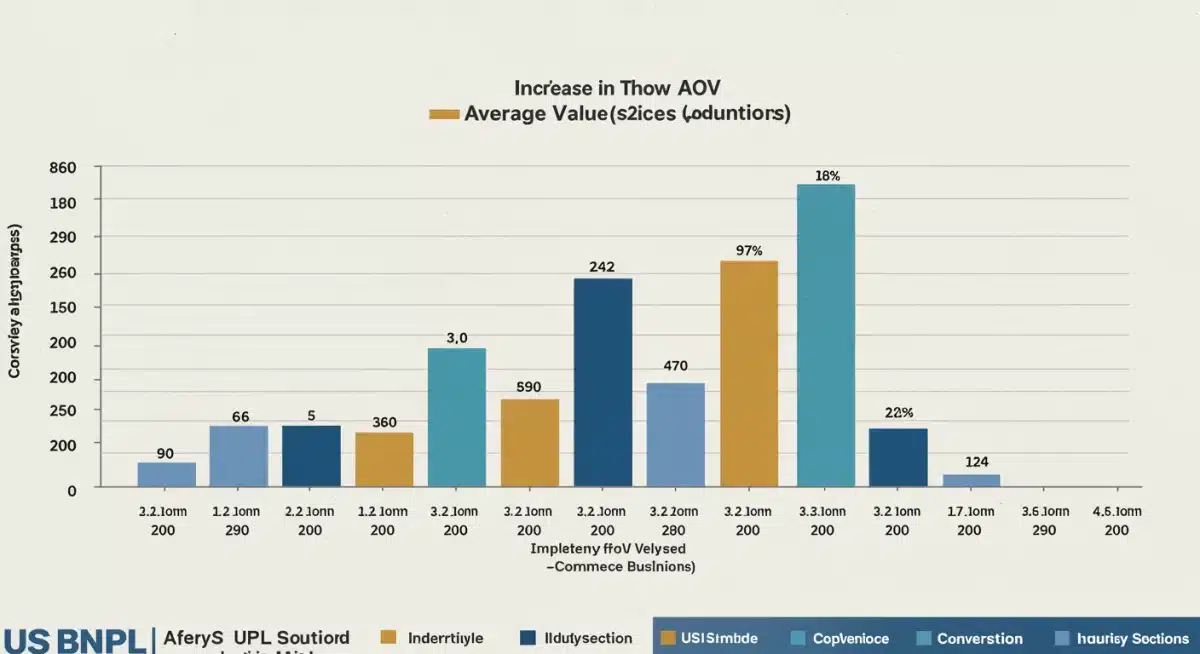
In summary, a rigorous methodology centered around relevant KPIs and systematic data analysis is paramount for understanding the short-term financial gains derived from BNPL. This structured approach ensures that the ROI figures are not only accurate but also actionable for strategic planning.
Anticipated Financial Returns: A 3-Month Projection
For businesses engaged in Implementing Buy Now, Pay Later (BNPL) Solutions: A 3-Month ROI Analysis for US E-commerce in 2025 (FINANCIAL IMPACT), projecting financial returns over a short period is essential for justifying investment and optimizing strategy. This section outlines the anticipated financial benefits that e-commerce businesses can expect within the first three months of integrating BNPL.
These projections are based on current market trends, historical data from early adopters, and expert analyses, offering a realistic outlook for US e-commerce retailers in 2025. The immediate impact often includes an uptick in key sales metrics.
Increased Average Order Value (AOV)
One of the most immediate and significant financial benefits of BNPL is the increase in Average Order Value (AOV). When consumers can spread the cost of a purchase over several installments, they are more likely to opt for higher-priced items or add more products to their cart.
This psychological effect of making large purchases feel more affordable directly translates into higher revenue per transaction. Within the first three months, many businesses report a noticeable bump in their AOV, contributing significantly to overall sales growth. This boost is particularly pronounced for retailers selling mid-to-high-value goods.
Boost in Conversion Rates and Reduced Cart Abandonment
BNPL acts as a powerful tool to combat cart abandonment, a persistent challenge for e-commerce sites. By offering a flexible payment alternative at checkout, businesses can significantly reduce the number of potential sales lost due to payment friction or perceived affordability issues.
- Simplified checkout process enhances user experience.
- Flexible payment options address budget constraints.
- Perceived lower immediate cost encourages completion of purchase.
The convenience of BNPL often leads to a measurable increase in conversion rates within the initial three-month period. This improvement directly impacts the top-line revenue, as more browsers become buyers.
New Customer Acquisition and Enhanced Loyalty
Beyond immediate sales, BNPL solutions are effective in attracting new customer segments, particularly those who prefer flexible payment options or are hesitant to use traditional credit. This widens a retailer’s market reach and brings in fresh revenue streams.
Furthermore, the positive experience associated with flexible payments can foster greater customer loyalty and repeat purchases. Satisfied customers are more likely to return, contributing to an increased Customer Lifetime Value (CLV) over time, although this might be more fully realized beyond the initial three months.
In conclusion, the first three months of BNPL implementation are expected to yield substantial financial returns through increased AOV, higher conversion rates, and new customer acquisition. These immediate gains underscore the strategic value of integrating BNPL into an e-commerce platform.
Cost Considerations and Implementation Challenges
While the financial benefits of Implementing Buy Now, Pay Later (BNPL) Solutions: A 3-Month ROI Analysis for US E-commerce in 2025 (FINANCIAL IMPACT) are compelling, it is crucial to address the associated costs and potential implementation challenges. A clear understanding of these factors is necessary for a realistic ROI calculation and smooth integration.
Ignoring potential hurdles can lead to unexpected expenses and delays, undermining the anticipated benefits. This section provides a balanced perspective on the financial outlay and operational complexities involved in adopting BNPL.
Integration Costs and Merchant Fees
Implementing BNPL solutions is not without cost. Merchants typically incur integration fees and ongoing transaction fees, which vary depending on the chosen BNPL provider and the volume of sales. These costs must be factored into the ROI analysis to ensure accuracy.
Integration costs can include setting up the payment gateway, updating e-commerce platforms, and ensuring seamless data flow. Merchant fees, usually a percentage of the transaction value, are a continuous expense that directly impacts profit margins. Careful negotiation with providers is essential to secure favorable terms.
Operational Adjustments and Potential Risks
Beyond financial costs, businesses must prepare for operational adjustments and potential risks. Integrating a new payment system requires training staff, updating internal processes, and potentially adjusting customer service protocols to handle BNPL-related inquiries.
- Staff training on new payment procedures.
- Updates to accounting and reconciliation processes.
- Potential for increased returns or disputes, though often mitigated by BNPL providers.
- Compliance with evolving regulatory landscapes for consumer credit.
One notable risk involves managing potential increases in returns, as the ease of purchase might lead some consumers to buy items they are less committed to. However, many BNPL providers offer robust dispute resolution mechanisms, mitigating this risk for merchants. Furthermore, staying abreast of regulatory changes in the consumer credit space is vital to avoid compliance issues.
In summary, a successful BNPL implementation requires a comprehensive understanding of both the upfront and ongoing costs, as well as proactive planning for operational changes and potential risks. Addressing these factors head-on ensures a smoother transition and a more accurate forecast of ROI.
Optimizing BNPL Strategy for Maximum ROI
To maximize the financial benefits from Implementing Buy Now, Pay Later (BNPL) Solutions: A 3-Month ROI Analysis for US E-commerce in 2025 (FINANCIAL IMPACT), businesses must move beyond mere integration to strategic optimization. This involves refining the BNPL offering to align with customer needs and business objectives, ensuring every dollar invested yields the highest possible return.
Optimization is an ongoing process that requires continuous monitoring, analysis, and adaptation. It’s about fine-tuning the BNPL experience to drive both immediate sales and long-term customer loyalty.
Strategic Placement and Promotion
The visibility and promotion of BNPL options significantly influence their adoption rate. Simply offering BNPL at checkout is often not enough; it needs to be strategically placed throughout the customer journey.
- Highlight BNPL on product pages to influence purchase decisions early.
- Feature BNPL prominently during the checkout process.
- Integrate BNPL messaging in marketing campaigns and advertisements.
By making BNPL options conspicuous and explaining their benefits clearly, businesses can encourage more customers to utilize these flexible payment methods, thereby increasing AOV and conversion rates. Effective communication about the transparency and ease of BNPL plans is key.
Data-Driven Personalization
Leveraging customer data to personalize BNPL offers can dramatically enhance its effectiveness. Understanding customer demographics, purchasing history, and preferences allows businesses to tailor promotions and payment plans that resonate most with individual shoppers.
For example, offering specific BNPL terms for high-value segments or promoting it more aggressively to new customers who typically start with smaller purchases can yield better results. This data-driven approach ensures that BNPL is not a one-size-fits-all solution but a customizable tool for maximizing sales across different customer profiles.
Continuous Monitoring and Iteration
The e-commerce landscape is dynamic, and so too should be the BNPL strategy. Continuous monitoring of KPIs and customer feedback is essential for identifying areas for improvement and adapting to market changes. Regular analysis of AOV, conversion rates, and customer acquisition costs related to BNPL will inform necessary adjustments.
Iteration based on these insights, whether it’s experimenting with different BNPL providers, adjusting promotional strategies, or refining communication, ensures that the BNPL offering remains optimized for maximum ROI. This proactive approach helps businesses stay ahead of competitors and maintain a strong financial performance.
Ultimately, optimizing a BNPL strategy involves a combination of smart placement, data-driven personalization, and a commitment to continuous improvement. These elements collectively ensure that BNPL serves as a powerful engine for growth in the competitive US e-commerce market.
Case Studies and Industry Benchmarks
To further illustrate the financial potential of Implementing Buy Now, Pay Later (BNPL) Solutions: A 3-Month ROI Analysis for US E-commerce in 2025 (FINANCIAL IMPACT), examining real-world case studies and industry benchmarks provides invaluable context. These examples offer tangible evidence of the benefits and challenges faced by businesses that have already adopted BNPL.
Learning from the experiences of others, particularly within the US e-commerce sector, can help new adopters set realistic expectations and avoid common pitfalls. Benchmarking against industry leaders also highlights best practices for integration and optimization.
Success Stories from US Retailers
Numerous US e-commerce retailers across various sectors have reported significant positive outcomes after integrating BNPL solutions. These success stories often highlight a rapid increase in sales volume, AOV, and customer satisfaction within the first few months.
For instance, a leading apparel retailer observed a 20% increase in AOV and a 15% rise in conversion rates shortly after introducing a popular BNPL option. Similarly, an electronics vendor noted a substantial reduction in cart abandonment for high-ticket items, directly attributable to the availability of flexible payment plans. These examples underscore the immediate financial uplift BNPL can provide.
Comparative Analysis with Industry Averages
Benchmarking an individual business’s performance against industry averages provides a crucial reality check. While specific results vary, general trends indicate that US e-commerce businesses leveraging BNPL typically experience:
- An average AOV increase of 10-30%.
- Conversion rate improvements ranging from 5-20%.
- A notable rise in new customer acquisition, particularly among younger demographics.
These benchmarks serve as a guide for businesses to assess their own BNPL performance and identify areas where they might be outperforming or underperforming the market. It also helps in setting achievable targets for future growth and optimization efforts.
In conclusion, case studies and industry benchmarks offer compelling evidence of BNPL’s financial efficacy in US e-commerce. They provide practical insights into what businesses can expect and how they can strategize to achieve similar or even superior results within a three-month timeframe.
Future Trends and Long-Term Impact of BNPL
Beyond the immediate 3-month ROI, understanding the future trends and long-term impact of Implementing Buy Now, Pay Later (BNPL) Solutions: A 3-Month ROI Analysis for US E-commerce in 2025 (FINANCIAL IMPACT) is vital for sustained strategic planning. BNPL is not a fleeting trend but a fundamental shift in consumer finance, with implications extending far into the future.
As the market matures and technology evolves, BNPL solutions are expected to become even more integrated into the e-commerce ecosystem, offering new opportunities and posing new challenges for retailers.
Evolving Regulatory Landscape
The rapid growth of BNPL has attracted increased scrutiny from regulators in the US and globally. As BNPL services become more prevalent, expect to see further development in consumer protection laws and financial regulations. Businesses will need to stay agile and ensure compliance with these evolving standards.
This regulatory evolution aims to protect consumers from potential debt accumulation and ensure fair lending practices. For e-commerce businesses, this means maintaining transparency in BNPL offerings and partnering with reputable providers who adhere to best practices.
Integration with Emerging Technologies
The future of BNPL will likely see deeper integration with emerging technologies, enhancing user experience and expanding its applicability. This includes:
- Artificial intelligence (AI) for personalized payment plans and risk assessment.
- Blockchain technology for enhanced security and transparency in transactions.
- Integration with digital wallets and voice commerce for seamless checkout experiences.
These technological advancements will make BNPL even more convenient and accessible, further solidifying its role as a preferred payment method for online shoppers. Retailers who embrace these integrations early will gain a significant competitive advantage.
BNPL as a Loyalty and Retention Tool
In the long term, BNPL is poised to become a powerful tool for customer loyalty and retention. By offering a consistent, positive payment experience, businesses can build stronger relationships with their customers, encouraging repeat purchases and fostering brand advocacy.
The ability to offer flexible payment options can differentiate a brand in a crowded market, making it the preferred choice for consumers seeking financial flexibility. This long-term impact on customer lifetime value (CLV) is a crucial aspect of BNPL’s strategic importance, extending well beyond the initial three-month ROI.
In conclusion, the future of BNPL in US e-commerce is characterized by continuous evolution, driven by regulatory changes, technological advancements, and its growing role in customer loyalty. Businesses that strategically adapt to these trends will reap sustained financial benefits and maintain a leading edge in the market.
| Key Aspect | Brief Description |
|---|---|
| ROI Drivers | Increased AOV, higher conversion rates, and new customer acquisition are primary drivers of immediate ROI. |
| Cost Factors | Integration fees, ongoing merchant fees, and operational adjustments must be considered for accurate ROI. |
| Optimization Strategy | Strategic placement, data-driven personalization, and continuous monitoring are key for maximizing returns. |
| Long-Term Impact | BNPL influences customer loyalty, retention, and adapts to evolving regulations and technologies. |
Frequently Asked Questions about BNPL ROI
While specific figures vary by industry and implementation quality, many US e-commerce businesses report a positive ROI within three months, driven by increases in average order value (AOV) of 10-30% and conversion rates of 5-20%. These immediate gains often outweigh initial setup and transaction fees.
BNPL typically increases AOV by making higher-priced items more accessible to consumers. The ability to split payments encourages shoppers to purchase more or opt for premium products, leading to a noticeable uplift in the average value of each transaction within the first few months.
The primary costs include integration fees for setting up the BNPL service on your e-commerce platform, and ongoing merchant fees, usually a percentage of each transaction. Operational adjustments, such as staff training, also represent an indirect cost that needs to be factored into the overall financial analysis.
Yes, BNPL is highly effective in reducing cart abandonment. By offering flexible payment options at checkout, it addresses common reasons for abandonment, such as budget constraints or perceived high upfront costs, thereby converting more browsers into buyers and boosting conversion rates.
Beyond immediate ROI, BNPL fosters customer loyalty and retention by providing a positive payment experience. It also helps attract new customer segments, enhances brand differentiation, and positions businesses to adapt to future payment innovations and evolving consumer financial behaviors.
Conclusion
The comprehensive analysis of Implementing Buy Now, Pay Later (BNPL) Solutions: A 3-Month ROI Analysis for US E-commerce in 2025 (FINANCIAL IMPACT) unequivocally demonstrates its strategic importance for online retailers. Within a short three-month window, businesses can anticipate significant financial returns driven by increased average order values, higher conversion rates, and the acquisition of new customer segments. While initial costs and operational adjustments are factors to consider, strategic optimization and a clear understanding of the evolving market ensure that BNPL remains a powerful tool for growth. As US e-commerce continues its rapid evolution, BNPL is not merely a payment option but a fundamental component of a forward-thinking, customer-centric business strategy, promising sustained financial benefits and enhanced market competitiveness.