Tokenization’s Impact on US Payment Security: 2025 Outlook

Payment tokenization security is set to become an indispensable pillar for US merchants by 2025, fundamentally transforming how sensitive financial data is protected against evolving cyber threats.
The landscape of digital commerce is constantly shifting, and with it, the threats to sensitive payment data. For US merchants, understanding and implementing robust security measures is not just good practice, it’s a critical imperative for survival and growth. This article delves into the impact of tokenization on payment security: a 2025 outlook for US merchants (INSIDER KNOWLEDGE), exploring how this technology is becoming the cornerstone of secure transactions and what businesses need to know to stay ahead.
Understanding tokenization: the foundation of future payment security
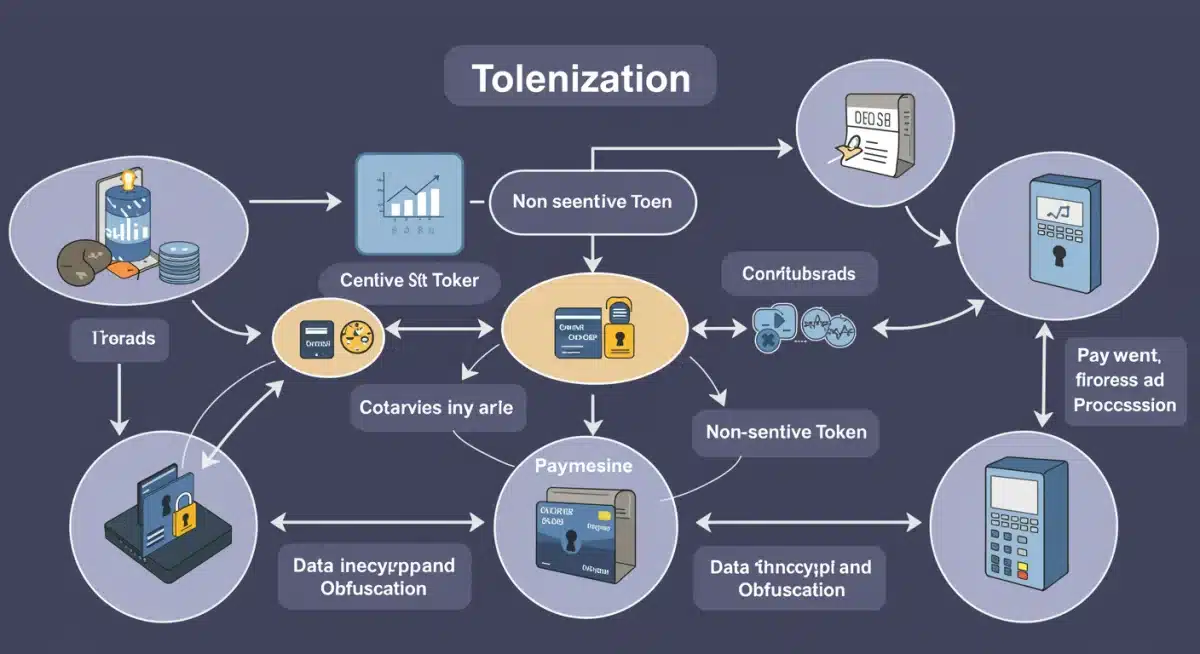
Tokenization is a process that replaces sensitive data, such as a 16-digit primary account number (PAN), with a unique, non-sensitive identifier called a token. This token holds no intrinsic value and cannot be reverse-engineered to reveal the original data, even if intercepted. It’s a fundamental shift from traditional encryption, offering a superior layer of protection.
For US merchants, this technology significantly reduces the risk associated with storing and transmitting payment card data. Instead of keeping actual card numbers on file, merchants store tokens, which are useless to cybercriminals. This makes breaches far less impactful and helps businesses comply with stringent data security standards.
How tokenization works in practice
When a customer makes a purchase, their payment card data is sent to the payment gateway. Before it reaches the merchant’s system or is stored, the sensitive information is converted into a token. This token is then used for all subsequent transactions and data storage. The original card data is securely stored in a token vault managed by a third-party payment processor, away from the merchant’s direct environment.
- Data replacement: Sensitive card numbers are substituted with random, unique tokens.
- Irreversible: Tokens cannot be mathematically converted back to the original card data.
- Reduced scope: Merchant systems only handle tokens, drastically reducing the PCI DSS compliance burden.
In essence, tokenization acts as a digital decoy, protecting the real data by providing an unidentifiable placeholder. This method is becoming increasingly vital as cyberattacks grow in sophistication and frequency, especially for businesses operating in the dynamic US market.
The evolving threat landscape for US merchants
US merchants face a relentless barrage of cyber threats, from sophisticated phishing schemes to large-scale data breaches. The value of payment card data on the dark web makes it a prime target for criminals. Traditional security measures, while important, often struggle to keep pace with these rapidly evolving threats.
The financial and reputational costs of a data breach can be catastrophic for businesses of all sizes. Fines, legal fees, customer churn, and brand damage can quickly cripple an organization. This stark reality underscores the urgent need for proactive and robust security solutions beyond mere compliance checkboxes.
Common attack vectors targeting payment data
Cybercriminals employ a variety of tactics to steal payment information. Understanding these methods is the first step in building effective defenses.
- Skimming: Physical devices illegally installed on POS terminals to capture card data.
- Phishing/Social Engineering: Tricking employees or customers into revealing sensitive information.
- Malware and Ransomware: Malicious software designed to infiltrate systems and steal or encrypt data.
- Brute Force Attacks: Automated attempts to guess passwords or encryption keys.
The sheer volume of transactions processed by US merchants makes them particularly attractive targets. Each transaction represents a potential vulnerability if not adequately secured. Tokenization directly addresses many of these vulnerabilities by making the data itself worthless if compromised.
PCI DSS compliance and tokenization: a symbiotic relationship
The Payment Card Industry Data Security Standard (PCI DSS) is a set of security standards designed to ensure that all companies that accept, process, store, or transmit credit card information maintain a secure environment. While essential, achieving and maintaining full PCI DSS compliance can be a complex and resource-intensive endeavor for US merchants.
Tokenization plays a crucial role in simplifying PCI DSS compliance. By replacing sensitive PANs with tokens, merchants can significantly reduce the scope of their PCI DSS audits. Systems that only handle tokens, rather than actual card numbers, fall outside the strictest requirements of the standard, thereby reducing the compliance burden and associated costs.
Benefits of tokenization for PCI DSS scope reduction
Reducing the PCI DSS scope translates into tangible benefits for merchants, allowing them to allocate resources more efficiently and focus on core business operations.
- Fewer systems in scope: Only systems that process or store actual card data are subject to the full PCI DSS audit.
- Lower audit costs: With a smaller scope, the cost of external audits can be substantially reduced.
- Simplified processes: Internal security policies and procedures can be streamlined.
It’s important to note that tokenization doesn’t eliminate PCI DSS compliance entirely. Merchants still need to secure their tokenized environments and ensure that their token provider is also compliant. However, it shifts much of the burden away from the merchant’s direct infrastructure, making compliance more manageable and attainable.
The operational advantages for US merchants in 2025
Beyond security and compliance, tokenization offers a range of operational advantages that will be increasingly critical for US merchants by 2025. These benefits extend to customer experience, operational efficiency, and the ability to innovate securely.
For instance, tokenization enables seamless one-click payments and recurring billing, as customers’ card details don’t need to be re-entered for every transaction. This improves the checkout experience, reduces cart abandonment, and fosters customer loyalty. Merchants can also use tokens for analytics and marketing without ever touching sensitive card data.
Key operational benefits
The strategic implementation of tokenization can unlock significant efficiencies and opportunities for growth.
- Enhanced customer experience: Faster, more convenient checkouts and subscription services.
- Reduced fraud liability: Shifting some fraud liability to token providers in certain scenarios.
- Improved data analytics: Securely analyzing transaction patterns without exposing sensitive data.
- Facilitates innovation: Enables merchants to explore new payment methods and channels with less risk.
As the payments landscape becomes more competitive, merchants who can offer both security and convenience will gain a significant edge. Tokenization provides the underlying infrastructure to achieve this balance, supporting both traditional point-of-sale and burgeoning e-commerce operations.
Challenges and considerations for adoption
While the benefits of tokenization are clear, US merchants considering its adoption must also be aware of potential challenges and key considerations. Implementing any new technology requires careful planning, resource allocation, and a thorough understanding of its implications.
One primary challenge can be the integration process with existing payment systems and infrastructure. Merchants need to ensure compatibility with their current POS systems, e-commerce platforms, and payment gateways. Choosing the right tokenization provider is also critical, as their security protocols and reliability directly impact the merchant’s overall security posture.
Navigating the implementation process
A successful tokenization rollout requires a strategic approach and attention to detail.
- Provider selection: Evaluate vendors based on their security standards, integration capabilities, and support.
- System integration: Ensure seamless integration with existing payment processing infrastructure.
- Cost implications: Factor in setup fees, transaction costs, and ongoing maintenance.
- Employee training: Educate staff on the new processes and security protocols.
Merchants must conduct thorough due diligence and potentially seek expert advice to mitigate these challenges. The long-term benefits of enhanced security and streamlined compliance typically outweigh the initial investment and effort, but a clear roadmap is essential for a smooth transition.
The future of tokenization in 2025 and beyond
By 2025, tokenization is expected to be a near-universal standard for payment processing among US merchants. Its role will continue to expand beyond traditional credit card transactions to encompass other forms of digital payments, including mobile wallets, cryptocurrencies, and IoT-enabled commerce. The technology is foundational to the future of secure, seamless transactions.
Innovation in tokenization will likely focus on enhanced interoperability, allowing tokens to be used across different payment networks and platforms more easily. We may also see advancements in token lifecycle management and the integration of artificial intelligence and machine learning to detect and prevent token-related fraud more effectively.
Emerging trends and advancements
The landscape of payment security is dynamic, and tokenization will evolve to meet new demands.
- Cross-platform tokens: Tokens that can be used universally across various payment ecosystems.
- Advanced fraud detection: AI-powered analytics to identify anomalous token usage.
- Enhanced consumer control: Greater transparency and control for consumers over their tokenized data.
- Integration with biometric authentication: Pairing tokens with biometric verification for even stronger security.
The continued evolution of tokenization will further solidify its position as an indispensable technology for payment security. For US merchants, embracing these advancements will not only protect their businesses but also position them as leaders in secure and innovative commerce.
Preparing your business for a tokenized future
For US merchants, preparing for a future dominated by tokenization means more than just understanding the technology; it means actively integrating it into their operational and security strategies. This proactive approach will ensure resilience against cyber threats and foster trust with customers.
Start by assessing your current payment infrastructure and identifying areas where tokenization can be most effectively implemented. Engage with your payment processors and technology partners to understand their tokenization offerings and how they align with your business needs. Education and training for your team are also paramount to ensure a smooth transition and ongoing adherence to best practices.
Steps for successful tokenization adoption
A structured approach helps ensure a smooth and effective transition to tokenized payments.
- Conduct a security audit: Identify current vulnerabilities and data handling practices.
- Partner with experts: Collaborate with payment processors and security consultants experienced in tokenization.
- Phased implementation: Consider a gradual rollout to minimize disruption and address issues systematically.
- Ongoing monitoring: Continuously monitor tokenized transactions and systems for any anomalies or potential threats.
By taking these steps, US merchants can not only safeguard their operations but also leverage tokenization as a competitive advantage, demonstrating a commitment to customer data protection and modern payment solutions.
| Key Aspect | Brief Description |
|---|---|
| Core Function | Replaces sensitive payment data with non-sensitive tokens, rendering original data useless if breached. |
| PCI DSS Impact | Significantly reduces the scope and complexity of PCI DSS compliance for merchants. |
| Operational Benefits | Enables faster transactions, recurring billing, and secure data analytics, improving customer experience. |
| Future Outlook | Expected to be a universal standard by 2025, expanding to various digital payment methods and incorporating AI for fraud detection. |
Frequently asked questions about payment tokenization
Payment tokenization is a security process that converts sensitive payment card data, like a credit card number, into a unique, non-sensitive string of characters called a token. This token replaces the original data in transactions and storage, making it useless to unauthorized parties even if intercepted, thereby enhancing security for US merchants.
Tokenization significantly reduces the scope of PCI DSS compliance by removing sensitive card data from the merchant’s direct environment. When only tokens are stored and processed, fewer systems fall under the strictest PCI DSS requirements, simplifying audits and lowering the associated costs and complexities for US businesses.
No, tokenization and encryption are distinct. Encryption scrambles data into an unreadable format that can be decrypted with a key. Tokenization replaces data with a randomly generated, non-sensitive placeholder that cannot be mathematically reversed. While both enhance security, tokenization offers superior protection by not storing original data within the merchant’s reach.
For US merchants, the main benefits include enhanced payment security, reduced PCI DSS compliance burden, lower risk of data breaches, improved customer experience through faster checkouts, and the ability to securely conduct data analytics. It also reduces potential fraud liability and supports innovation in payment solutions.
Merchants should consider the integration complexity with existing systems, the reliability and security standards of their chosen tokenization provider, the overall cost implications, and the need for thorough employee training. A phased implementation strategy and continuous monitoring are also crucial for a successful transition.
Conclusion
As we look towards 2025, it’s clear that payment tokenization is not merely an optional security enhancement but a fundamental requirement for US merchants. Its ability to drastically reduce the risk of data breaches, simplify PCI DSS compliance, and improve operational efficiencies makes it an indispensable technology in the ongoing battle against cybercrime. By embracing tokenization, businesses can build a more secure, resilient, and customer-centric payment ecosystem, safeguarding their reputation and securing their future in the dynamic world of online commerce.